
Concrete-to-concrete connections under fire load according to EN 1992-1-2 using Hilti HIT-FP 700-R cementitious injection system
1. Understanding HIT-FP 700 R
HIT-FP 700 R is not just another injectable system; it represents a new technology in the realm of cement-based mortars. This unique product can be stored as paste for up to 12 months and stands out as the only chemical mortar that delivers high performance under fire without exhibiting creep behavior at elevated temperatures. This innovative technology necessitated an update to the previous EAD 330087-01.
One notable feature of HIT-FP 700 R is its low dispensing force across all temperature ranges, coupled with an extended working time. This makes it suitable for easy installation in deep embedment depths up to 2.5 meters.

1.1 Differences and similarities between HIT-FP 700 R, grouts and resin-based mortar
As an inorganic cement-based mortar, HIT-FP 700 R offers superior fire resistance compared to resin-based mortars and maintains stable performance at high temperatures. It combines the safe, flexible, and user-friendly application properties of resin-based mortars with the robust performance of inorganic grouts. This mortar is applied using Hilti's standard two-component injection system, which mitigates the risks associated with inconsistent mixing proportions often encountered with commercial grouts on job sites. Its tailored smooth consistency also reduces the need for large drilling diameters relative to the rebar size, minimizing the required amount of HIT-FP 700 R mortar.
The qualified anchoring mortar for post-installed rebars typically follows these guidelines:
- Declaration of performance based on EN 1504-6.
- European Technical Assessment (ETA) based on EAD 330087-02.
- Evaluation Service Report (ESR) based on ICC-ES AC308.
EN 1504-6 does not provide as detailed a qualification as the other two methods, potentially leading to conservatively designed connections. Post-installed rebars with ETA or ESR approval and designed according to ACI 318 or Eurocode 2 ensure safety levels comparable to cast-in rebar designs. Therefore, EN1504-6's Declaration of Performance does not offer adequate safety levels for post-installed rebar connections and is incompatible with existing building code design methods.

Figure 4: Installation of HIT-FP 700 R and generic grouts.
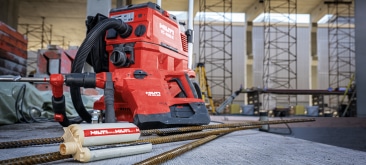
Additionally, HIT-FP 700 R features Hilti SafeSet technology, which automatically extracts dust during drilling and ensures the borehole is clean in compliance with ETA standards. The mortar is injected into the borehole using an automatic dispenser before the rebar is inserted. This system significantly enhances rebar robustness and reduces potential user errors during installation.
1.2 Detailed Installation Characteristics of HIT-FP 700 R
HIT-FP 700 R, like many cementitious products, has a significantly longer curing time (days) compared to standard injection systems (minutes). Small cracks and voids may appear in the material expelled from the top of the borehole due to shrinkage. These are not critical and are considered in the final ETA assessment.

Table 1: IFU table for HIT-FP 700 R – curing at different temperatures.
To support workflow and minimize waiting time, additional stages such as assembly time and pre-loading time have been incorporated into the Instructions for Use (IFU). This allows partial loading before the full design load can be applied.

Figure 5: load level in function of the time at different temperatures.
1.3 EAD Amendment: New State-of-the-Art for Cement-Based Mortars
The qualification of post-installed rebar connections is regulated by the European Assessment Document EAD 330087. Previous versions of this document covered both resin-based and cementitious mortars but were primarily used for resin-based products. The new Hilti technology facilitates the frequent use of fully cementitious mortars, prompting a review and update of qualification requirements to address specific characteristics of inorganic binders, such as microstructure stability and shrinkage behavior.
The updated EAD 330087-02 introduces a method to distinguish between resin-based and cement-based mortars through compositional analysis based on mass loss over temperature. It also includes new test protocols specifically for cement-based mortars. These tests assess the sensitivity of the rebar system to low-relative humidity concrete installations and the long-term stability of the mortar microstructure under severe weathering conditions. These new requirements ensure that the performance characteristics published in the ETA, particularly bond strength values, maintain the same reliability as those required for resin-based mortars. This updated qualification procedure represents the state-of-the-art for cement-based mortars.
2. Hilti PROFIS Engineering: An Easy Way to Select the Right Product for Fire Design
Hilti PROFIS Engineering software provides engineers with a quick and safer solution for designing post-installed rebars under fire conditions. The program determines splice and end anchorage lengths for accidental load combinations in hot conditions. It offers flexibility to model fire conditions by allowing users to input the required fire duration exposure or enter a constant temperature along the rebars calculated externally.
The software calculates the necessary drill lengths for post-installed rebar under fire conditions and generates clear, comprehensive design reports that document the fire design results. This functionality ensures precise, reliable outcomes and enhances the safety and efficiency of fire design in structural engineering.

Figure 6: PROFIS Engineering, Post-installed rebar design
Missed part 1 of this article? You can access it through this link.
The information provided in this article is for general information purposes only. While we strive to ensure the accuracy and reliability of the information presented, it is not intended as legal, technical or professional advice. Hilti makes no representations or warranties of any kind, express or implied, about the completeness, accuracy, reliability, or suitability, with respect to the article for any purpose.